
Five seats that barely move: this is how the 29-N poll tracking works on JaénYa
JaénYa gathers all published polls in its general election special and calculates the province's 5 deputies. We explain what the section offers, how it is calculated, what changes with and without the CIS and how to follow it until November 23.
Redacción ·
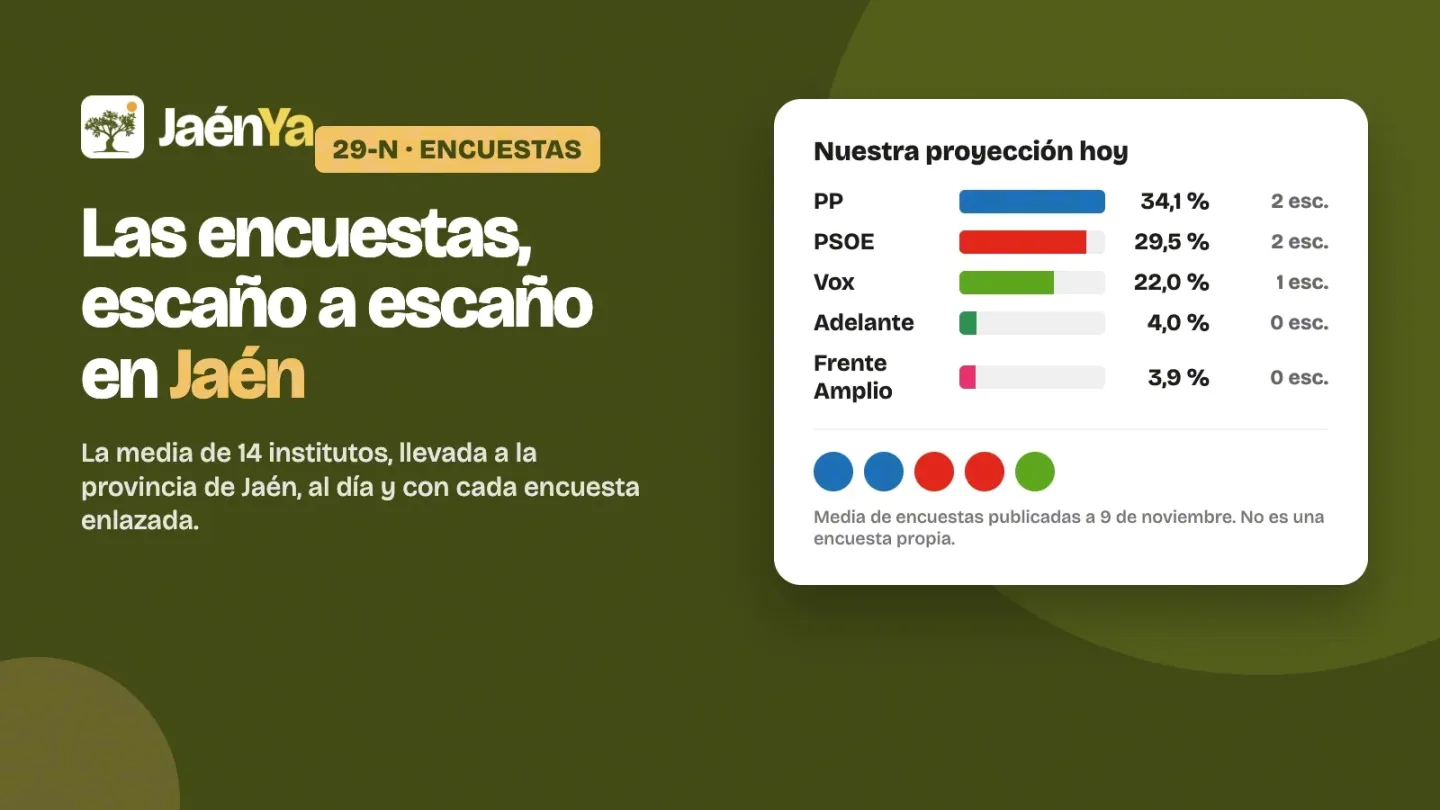
Jaén elects 5 deputies, and in a small province it takes a lot of votes to move a seat. That shows in the polls: the distribution barely changes from one week to the next. To follow it, the JaénYa general election special has a section that gathers all the polls, averages them and brings them to the province.
We tell you what it contains, how it works and why in Jaén the ranges come out so tight.
What you will find
The section is called «Qué dicen las encuestas» and is inside the JaénYa general election special. From top to bottom, this is what it contains:
- Our projection for the province of Jaén. The estimated vote for each party and its seats, with a range.
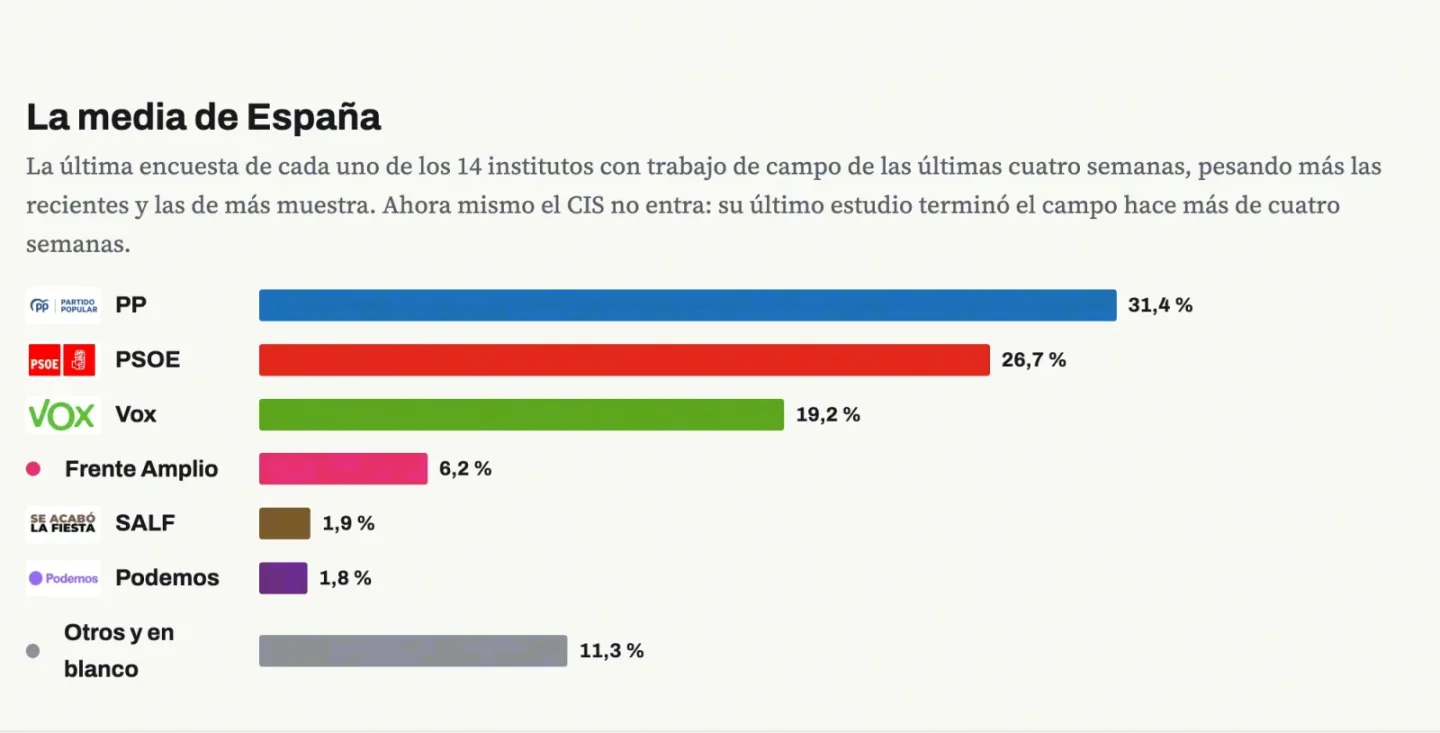
- The Spain average. The latest poll from each institute, weighted by date and size.
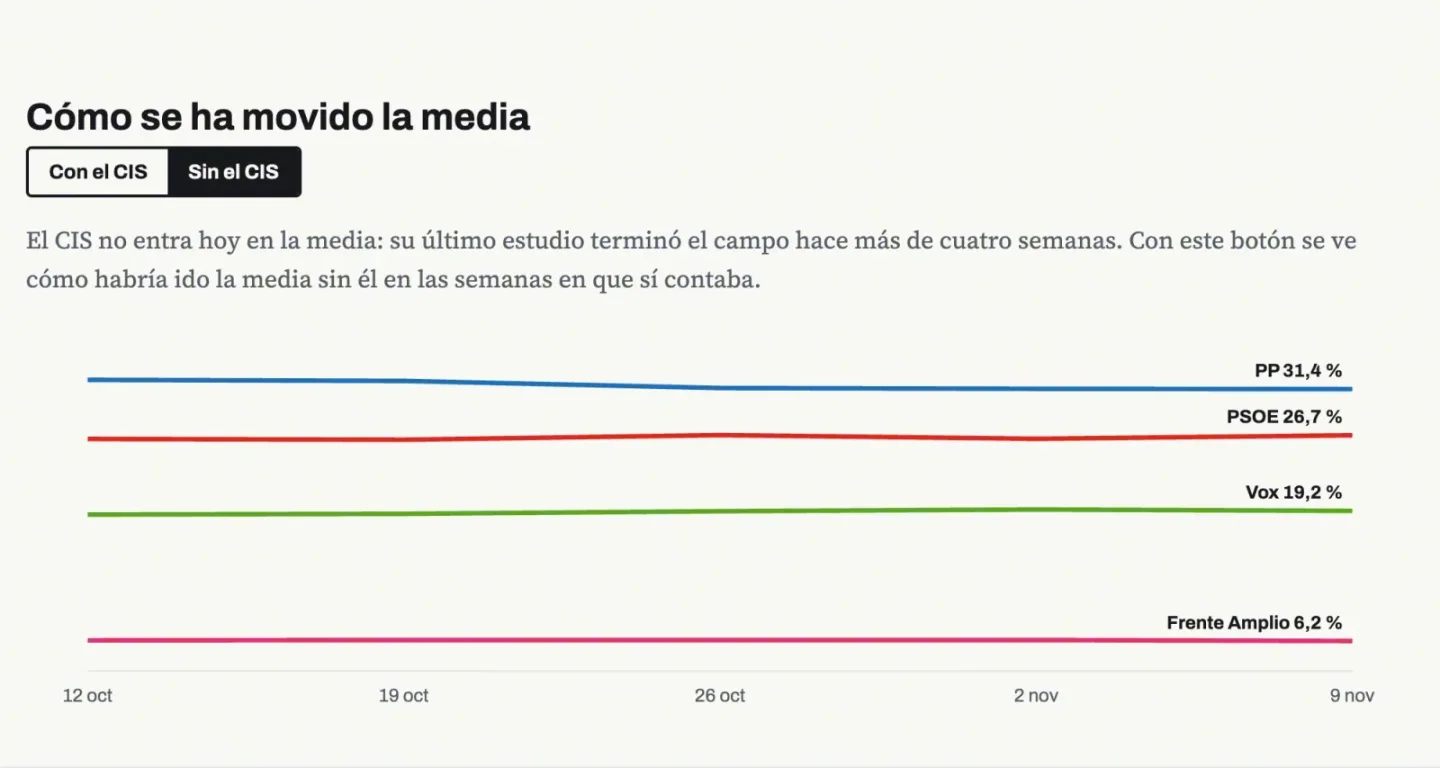
- How the average has moved. A week-by-week chart, with a button to view it with and without the CIS.
- What the institutes publish. The polls that give seats for Andalusia or for each province, untouched, to compare them with ours.
- Do your own count. A simulator with a control per party: raise or lower its vote in Andalusia and instantly see how the 60 seats would look, province by province.
- All the polls. The full table, from newest to oldest, with institute, outlet, fieldwork dates and technical details.
- How we do the average and the projection. The whole method, expandable, at the end.
What it says today for Jaén
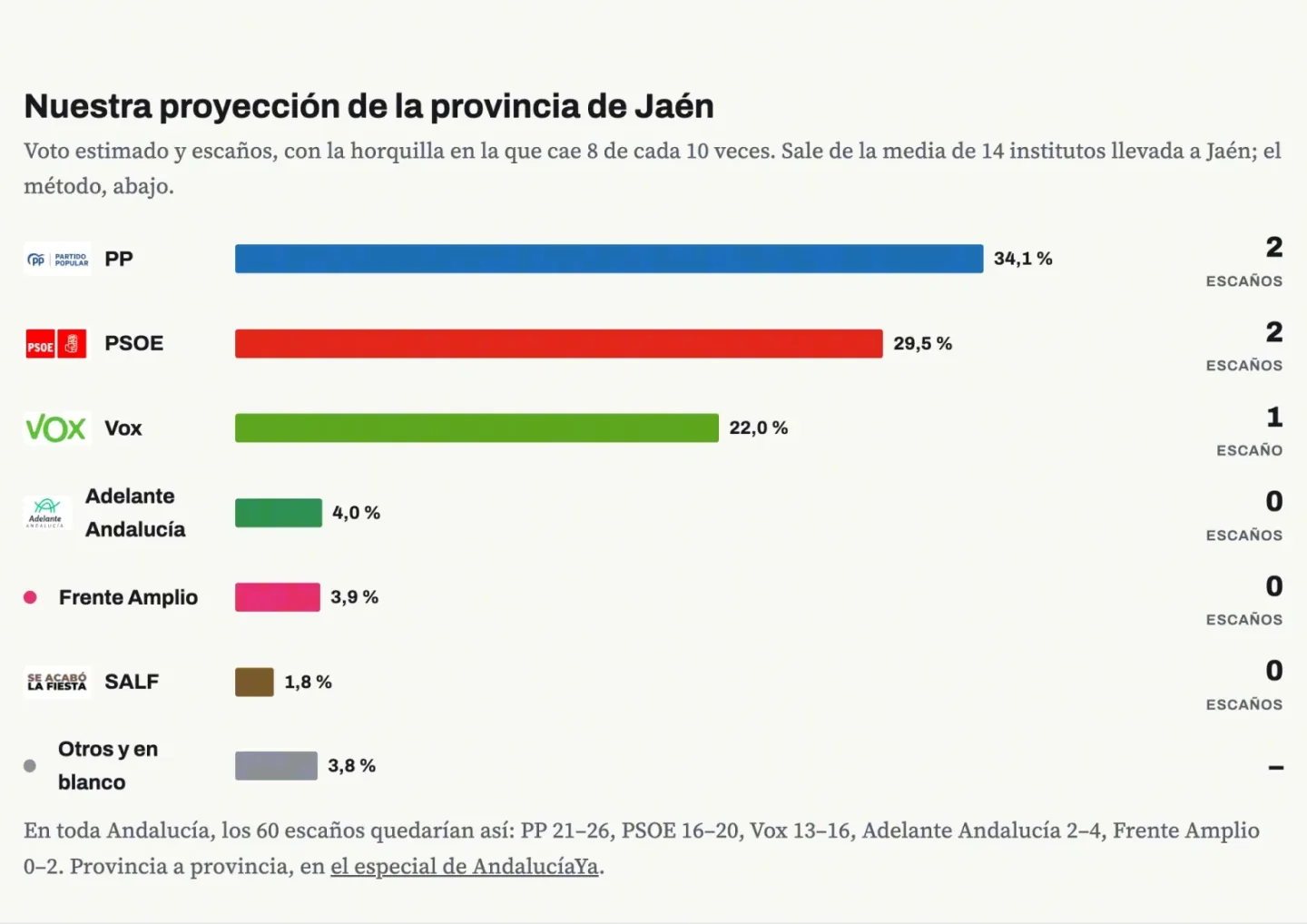
With the polls of November 9, the distribution would be the same as in 2023: PP 2, PSOE 2 and Vox 1, and with no range, because it comes out the same in 8 out of 10 repetitions. The PP would have 34.1% and the PSOE 29.5%. In 2023 they were one point apart (PP 37.3%, PSOE 36.3%); today the distance would be greater.
Vox would rise to 22.0%. Below, Adelante Andalucía (4.0%) and Frente Amplio (3.9%) would be far from a seat: with five in play, the last one costs more than 14% of the vote.
| Partido | Votos en 2023 | Escaños en 2023 | Proyección hoy | Escaños hoy (horquilla) |
|---|---|---|---|---|
| PP | 37,3 % | 2 | 34,1 % | 2 (2) |
| PSOE | 36,3 % | 2 | 29,5 % | 2 (2) |
| Vox | 14,8 % | 1 | 22,0 % | 1 (1) |
| Adelante Andalucía | – | 0 | 4,0 % | 0 (0) |
| Frente Amplio (Sumar en 2023) | 8,0 % | 0 | 3,9 % | 0 (0) |
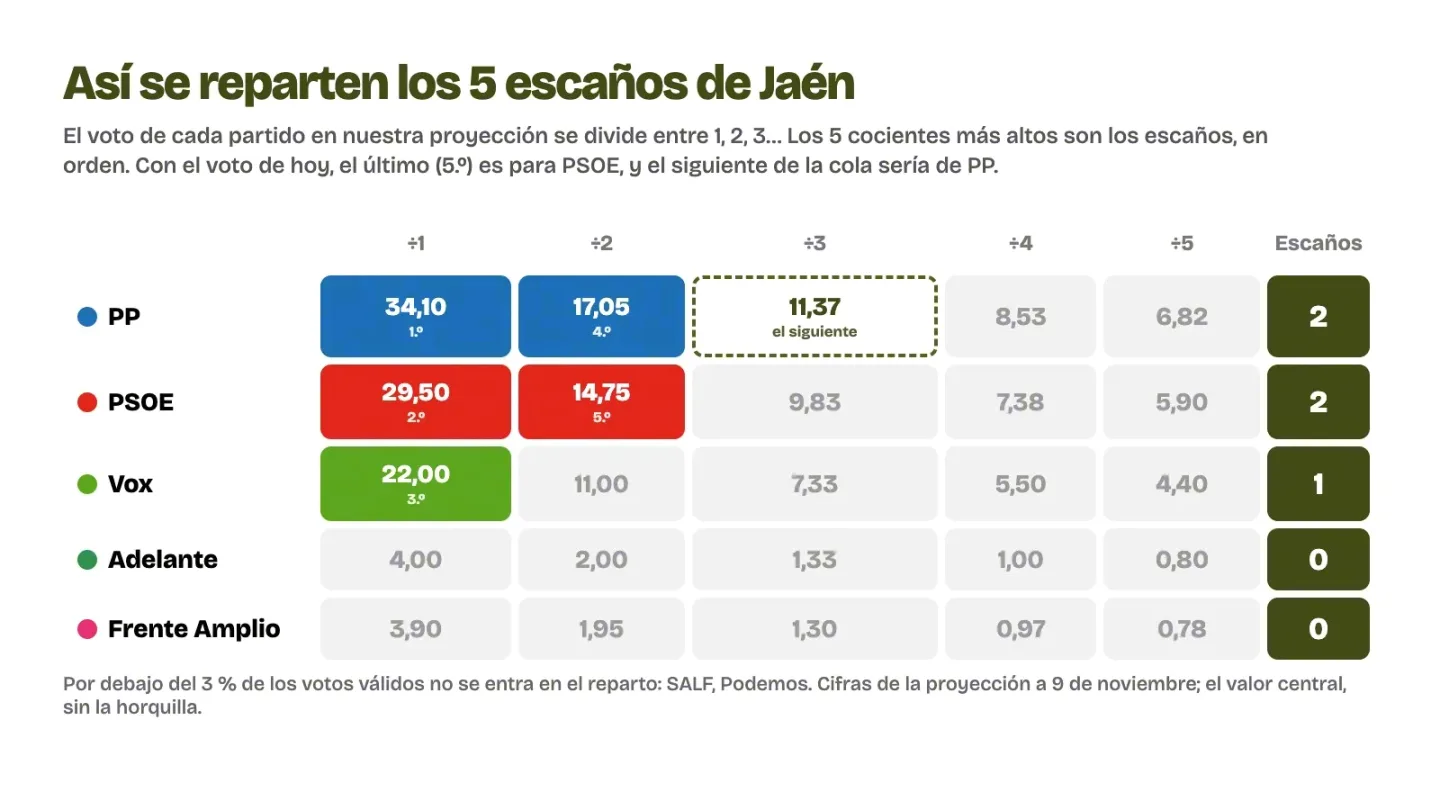
The image above is the distribution done by hand. Each column divides the vote by one more number; in colour, the 5 highest results, which are the seats, numbered in order of arrival. The last one in is won by PSOE with 14.75; just behind, PP waits with 11.37. The lead, of 3.38 points, is comfortable.
The recipe: four steps
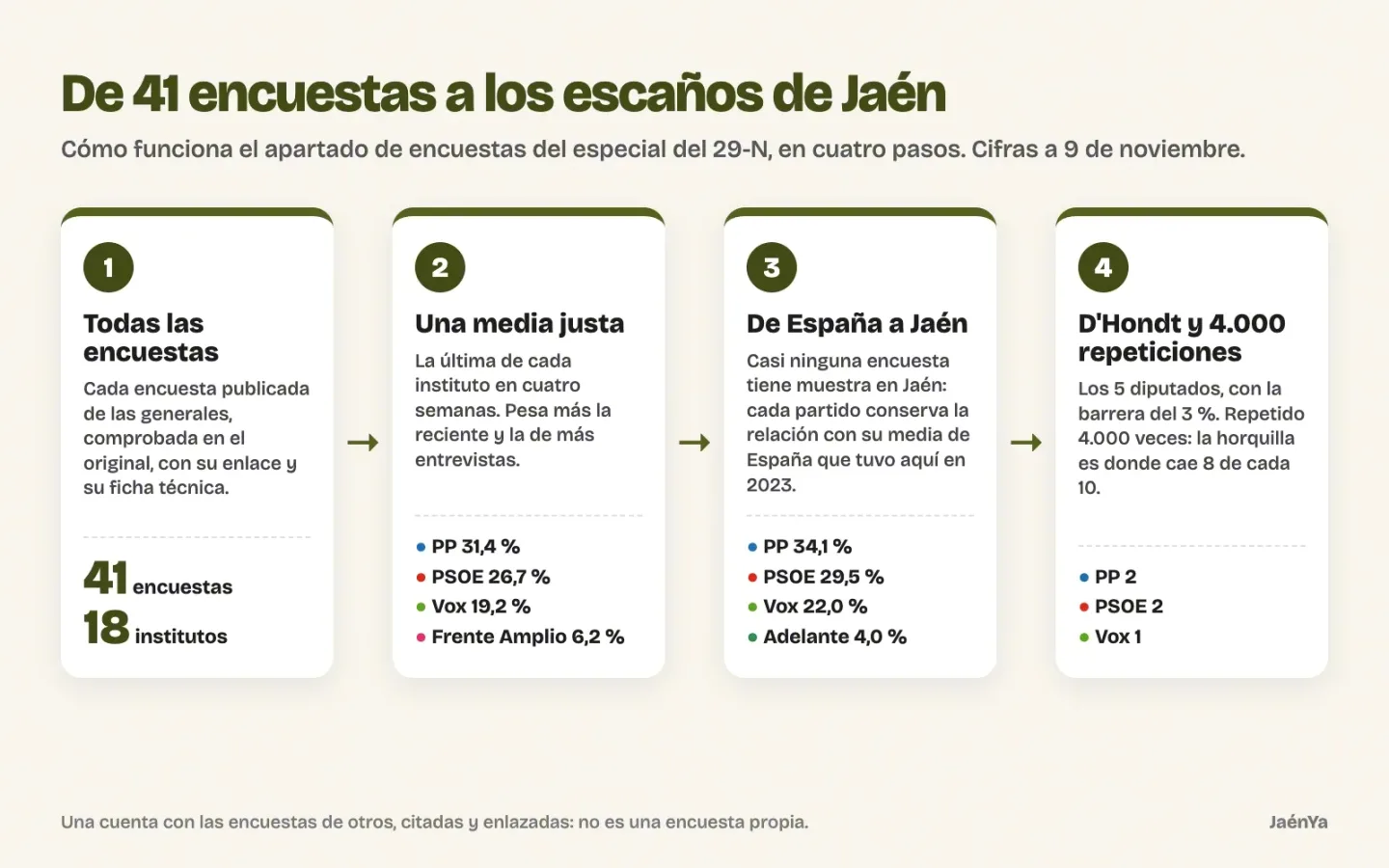
The first thing is to have all the polls. We don't pick the ones we like: all published polls for these general elections go in, 41 since October 1, always seen in their original source.
The second, to average them without any one dominating. From each institute, the most recent; if it is more than four weeks old, out. One of 4,000 interviews weighs more than one of 1,000, but not four times more (the square root of the sample counts), and one from fifteen days ago weighs half as much as one from today. That is how the 14 that make up today's average come out.
The third, to bring that average to Jaén. So as not to rely on the few interviews there are in Jaén, we take how each party behaved here compared with all of Spain in the 2023 general elections. In those elections the PSOE had 36.3% here (in Spain, 31.7%), the PP 37.3% (33.1%) and Vox 14.8% (12.4%). That relationship is carried over to today's average and, at the end, everything is readjusted so that it adds up to 100. With two exceptions: Podemos and SALF take the 2024 European elections as their base, and Adelante Andalucía the Andalusian elections of May.
The fourth, to turn it into seats. The 5 deputies of Jaén are assigned with D'Hondt, and only parties with at least 3% of the valid votes get in. Then we simulate the typical error of the polls 4,000 times; the range covers the central 80% of those results.
Two averages: with and without the CIS
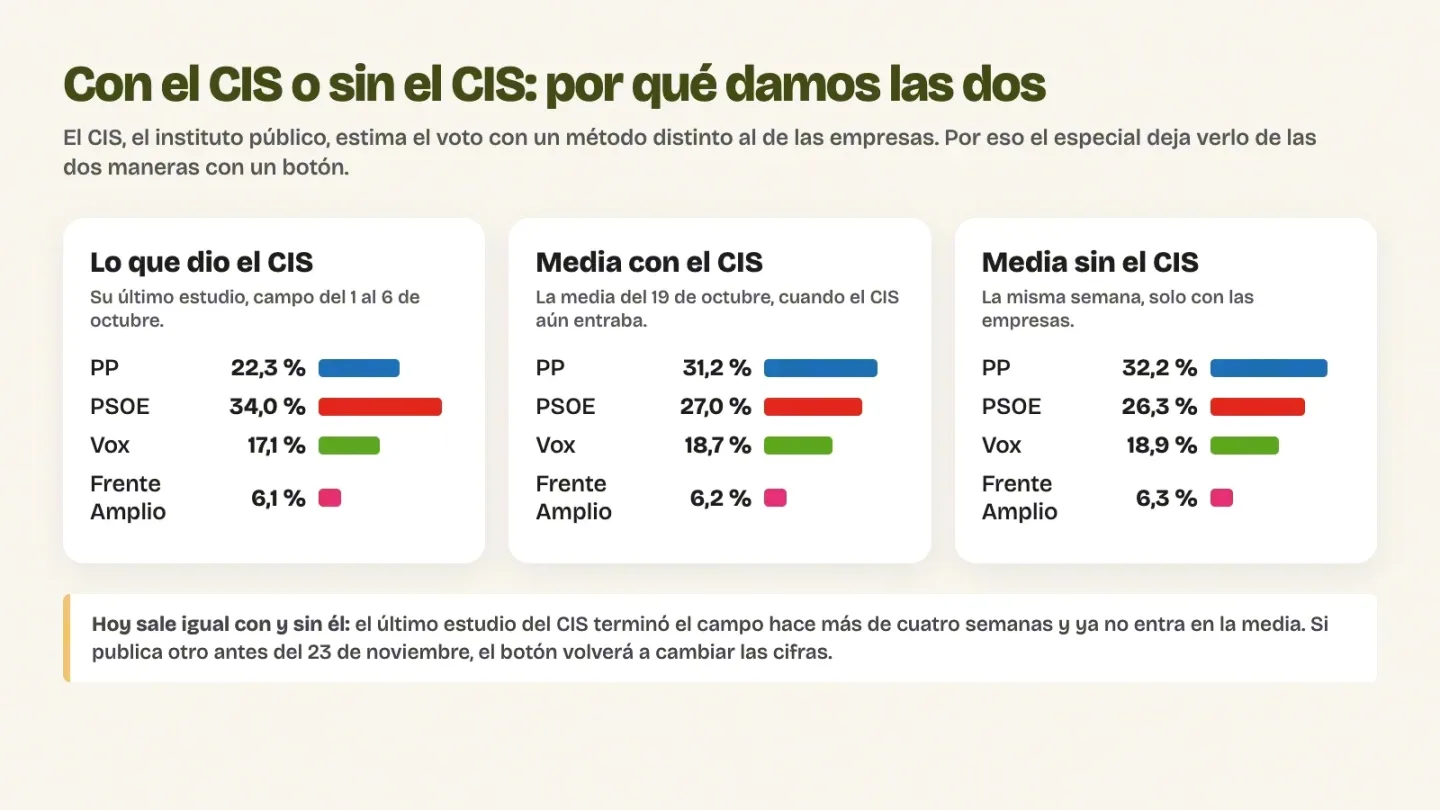
«Con el CIS» and «Sin el CIS» are the two ways of viewing the average that the special offers. The reason is simple: the CIS estimates with its own method and usually gives results very different from those of the private companies. In its October study (fieldwork from 1 to 6), the PSOE came out with 34.0% and the PP with 22.3%.
That study was in the average while it was less than four weeks old. In those days the button changed the figures: on October 19, the PP had 31.2% with the CIS and 32.2% without it. Now it has expired for the average, so today's projection does not depend on it. The button is still on the chart, to see how the average would have gone without the CIS in those weeks. If it publishes a new study before the November 23 cut-off, it will count again.
Do your own count
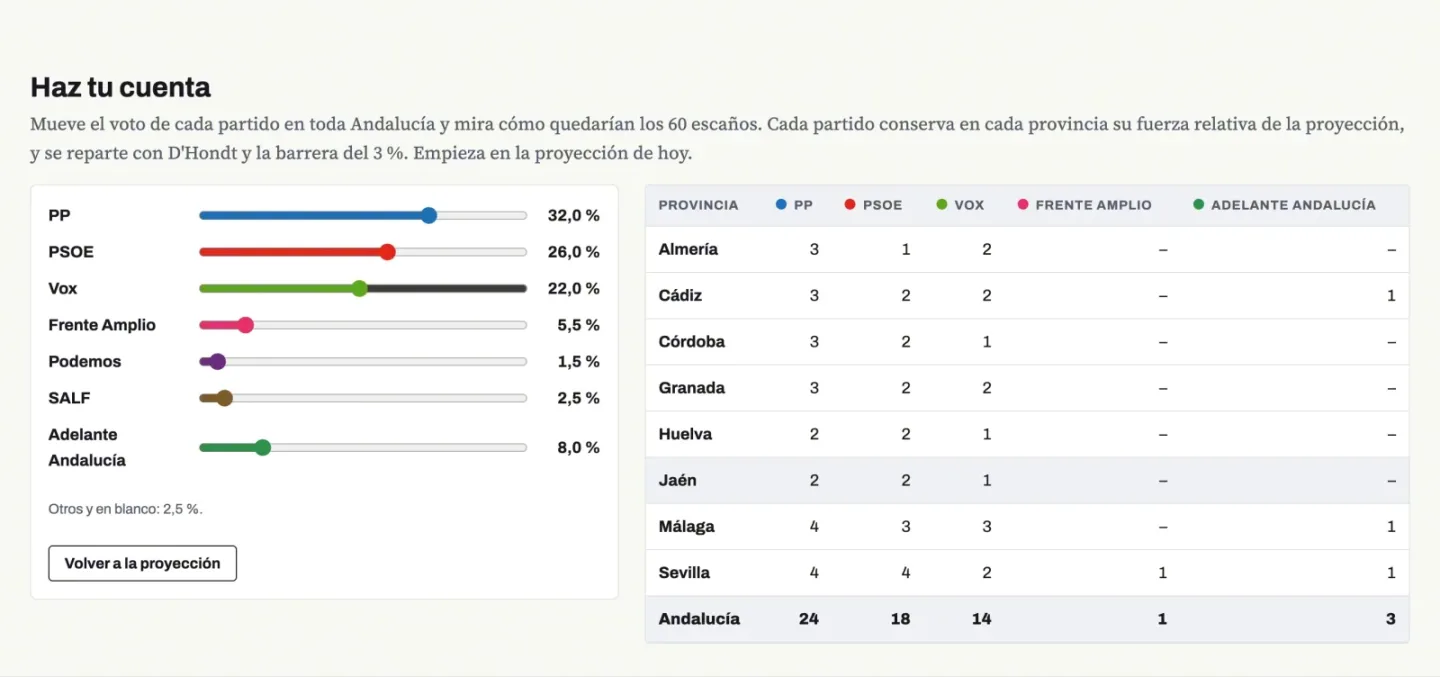
In a province of five seats, the simulator shows how difficult it is to move them: you will have to shift several points for the Jaén row to change. By contrast, Sevilla or Málaga react sooner. It is a good way to understand how the size of each constituency weighs.
In «Lo que publican los institutos», the Sigma Dos poll for El Mundo (fieldwork until October 14) gave exactly the same in Jaén: PP 2, PSOE 2 and Vox 1.
All the polls, with their link
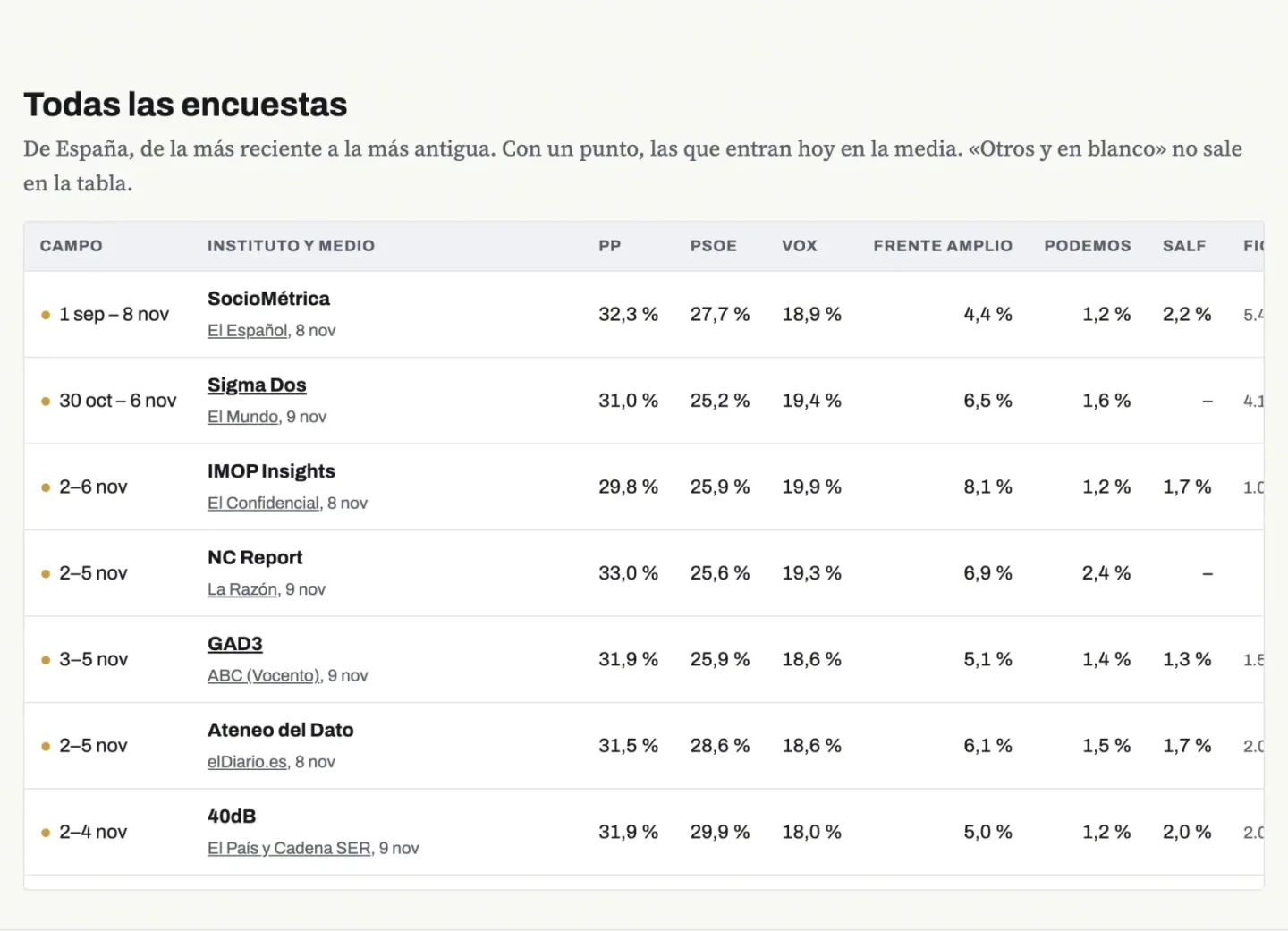
At the very bottom is the table with the 41 polls collected, each linked to the outlet that published it. It is the best way to check that the average hides nothing: you can see one by one what each institute said.
How to use it every day
We designed it so you can check it daily without wasting time. You open the section, look at the update date and go straight to the projection. If you want to know why something has changed, scroll down to the table: the new survey will be at the very top and marked with a dot.
The figures change little from one day to the next, and that is a good sign: an average like this does not get dragged along by a single striking survey. When it really moves, you can see it in the chart for several weeks in a row.
November 23 will be the last day with new data. From the 24th to the 28th, electoral law does not allow surveys to be published, so the section will stay as it is that day, with a notice explaining it.
The full 29-N special on the province of Jaén
Andalusia's 60 seats, on AndalucíaYa (opens outside the portal)
Breaking news from News, on your phone
An alert only when something can't wait. Free, no account needed.
On iPhone, alerts only arrive if you first add JaénYa to your Home Screen. How to do it, step by step
This browser can't receive alerts. Try another one, such as Chrome or Safari.
You've blocked alerts from JaénYa in this browser. You can turn them back on in its settings. How to do it, step by step
Only what can't wait. Change or remove it in my alerts
Shall we let you know what matters?
Phone alerts
On iPhone, alerts only arrive if you first add JaénYa to your Home Screen. How to do it, step by step
This browser can't receive alerts. Try another one, such as Chrome or Safari.
You've blocked alerts from JaénYa in this browser. You can turn them back on in its settings. How to do it, step by step